
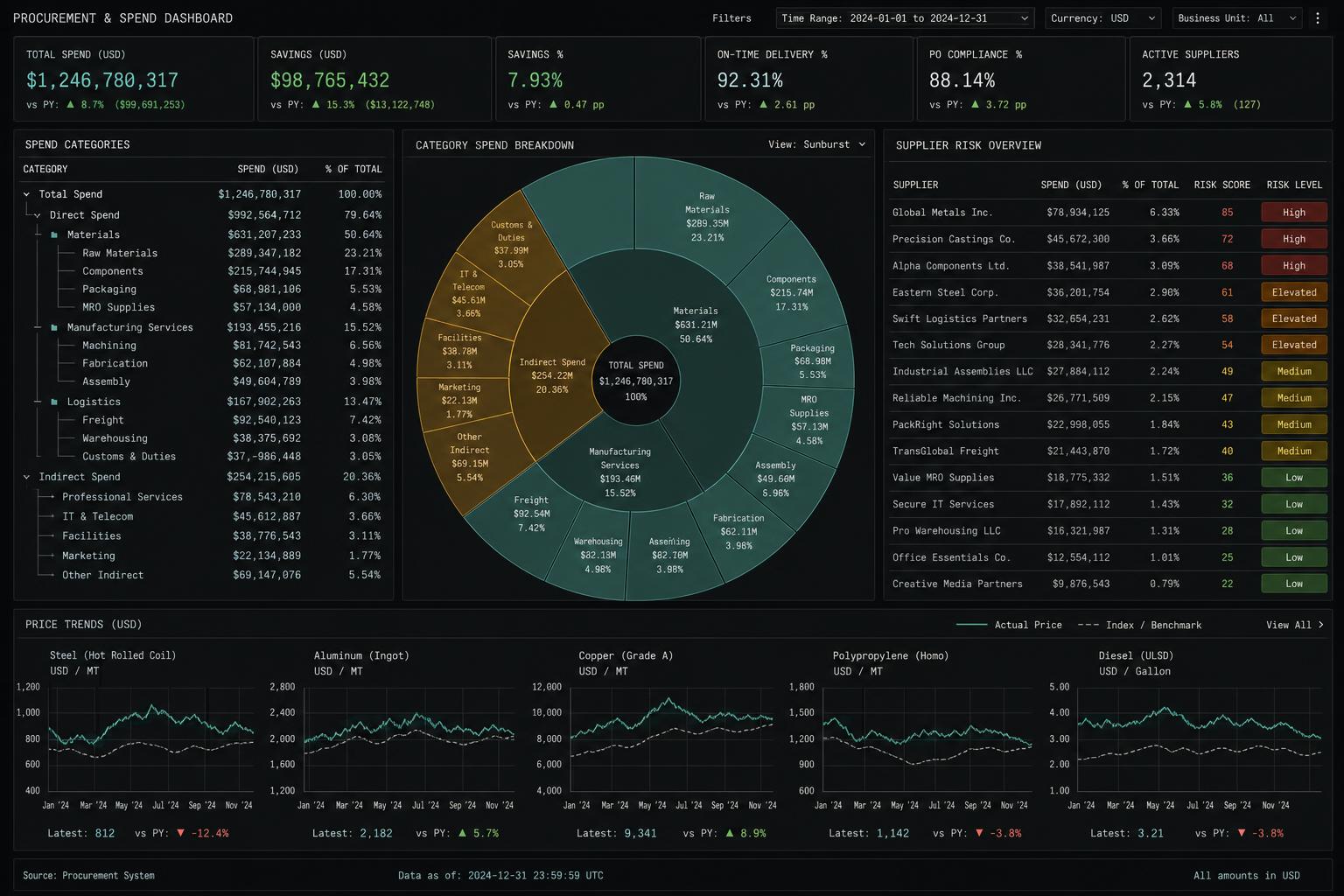
Procurement & Spend · Application portfolio
Procurement & Spend Intelligence
Connect spend to operational need - asset criticality, supplier risk, inventory, contracts, and field urgency in one view.
A concrete decision workflow
From operating question to accountable action.
Step 1
Operating question
Spend decisions are disconnected from operational need, asset criticality, supplier risk, inventory levels, contracts, and field urgency. Savings and risk both hide between systems.
Step 2
Connected evidence
Purchase orders & invoices · Suppliers & contracts · Inventory · Work orders · Budgets
Step 3
Assisted action
Spend visibility across categories, sites, and suppliers · Supplier risk views grounded in performance and exposure · Purchasing recommendations tied to operational need
Step 4
Human decision
Category review: Pull a category view across spend, suppliers, performance, and contract coverage - with anomalies surfaced.

Representative interface · Product status not independently verified · Not a customer deployment
Evidence stays attached to the decision.
Source context, recommendations, permissions, and operator review remain visible on the same working surface.
Built with the people who own the outcome.
The path begins with one bounded decision, connects the systems holding its evidence, puts a working surface in front of operators, then hardens permissions and audit before expanding.
Public customer case studies are not yet available. The workflows shown here are representative and are not customer attributions or performance claims.
One operating view · Procurement & Spend Intelligence
The same working path runs through every Ridgeline application.