
Industrial Operations · Application portfolio
Maintenance Intelligence
Connect work orders, sensor data, inspections, parts, and asset history into one decision layer - so maintenance teams act before things fail, not after.
A concrete decision workflow
From operating question to accountable action.
Step 1
Operating question
Maintenance teams often know what failed after it fails. Work orders, sensor data, inspections, alarms, spare parts, and asset history are rarely connected into one decision layer.
Step 2
Connected evidence
CMMS / EAM · Work orders · Asset history · SCADA & historians · Inspections & alarms
Step 3
Assisted action
Asset risk scoring grounded in operational data · Work prioritization aligned to criticality and parts availability · Early-warning signals from sensor and inspection patterns
Step 4
Human decision
Daily prioritization: Rank today's work by asset criticality, parts-on-hand, crew skill, and operational impact - with a clear rationale operators can challenge.
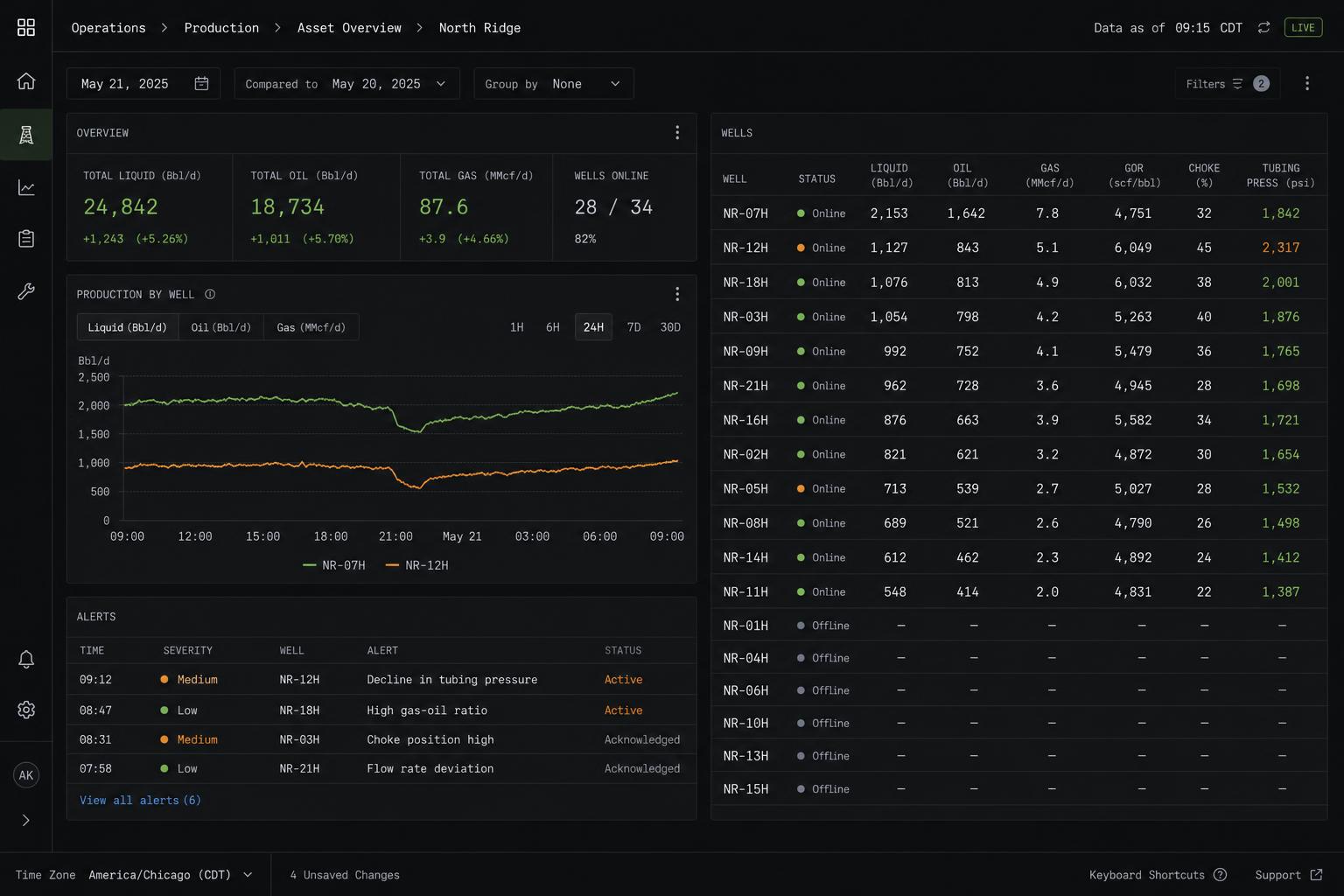
Representative interface · Product status not independently verified · Not a customer deployment
Evidence stays attached to the decision.
Source context, recommendations, permissions, and operator review remain visible on the same working surface.
Built with the people who own the outcome.
The path begins with one bounded decision, connects the systems holding its evidence, puts a working surface in front of operators, then hardens permissions and audit before expanding.
Public customer case studies are not yet available. The workflows shown here are representative and are not customer attributions or performance claims.
One operating view · Maintenance Intelligence
The same working path runs through every Ridgeline application.