

Ridgeline AI, an Element 29 company
Mixed property portfolio at a metro edge at dusk

Operational + Physical AI / PRINCIPLE

VULCAN.The operating systemfor real operations.

Enterprise evidence. Physical signals. Accountable action.

Designed across eight industries. Start with trusted sources, connect the workflow and verify the outcome.

Illustrative environment · not a client deployment

ESTABLISHED

one national operator, measured

several hundred
Datasets enumerated across the estate
20,000+
Columns catalogued
under half
Carrying a documented owner and a defensible definition
3%
Met the initial authority threshold

Measured at one national operator across one operator portfolio. Reported as evidence from one engagement, not as a sector benchmark. No client is named.

VULCAN / OPERATING WORLDS

Eight industries.
One operating system.

Different environments. Connected evidence, accountable decisions and a recorded outcome.

Facilities & Field Operations operating environmentIllustrative environment · not a client deployment
PRINCIPLE

Facilities & Field Operations

What needs attention before the next service window?

CONNECTS
Asset history, work orders, inspections and service obligations.
OPERATING VIEW
A shared view of readiness, missing evidence and open exceptions.
NEXT DECISION
Assign the work. Verify the closeout.
Industrial Operations operating environmentIllustrative environment · not a client deployment
PRINCIPLE

Industrial Operations

Which asset should the reliability team work on next?

CONNECTS
Process signals, maintenance history, parts and permits.
OPERATING VIEW
Asset condition connected to production consequence.
NEXT DECISION
Review the priority. Approve the maintenance window.
Critical Infrastructure operating environmentIllustrative environment · not a client deployment
PRINCIPLE

Critical Infrastructure

Where does service consequence change the priority?

CONNECTS
Asset inventories, network dependencies and known weaknesses.
OPERATING VIEW
An inspectable view of criticality and service exposure.
NEXT DECISION
Select the intervention. Keep control boundaries explicit.
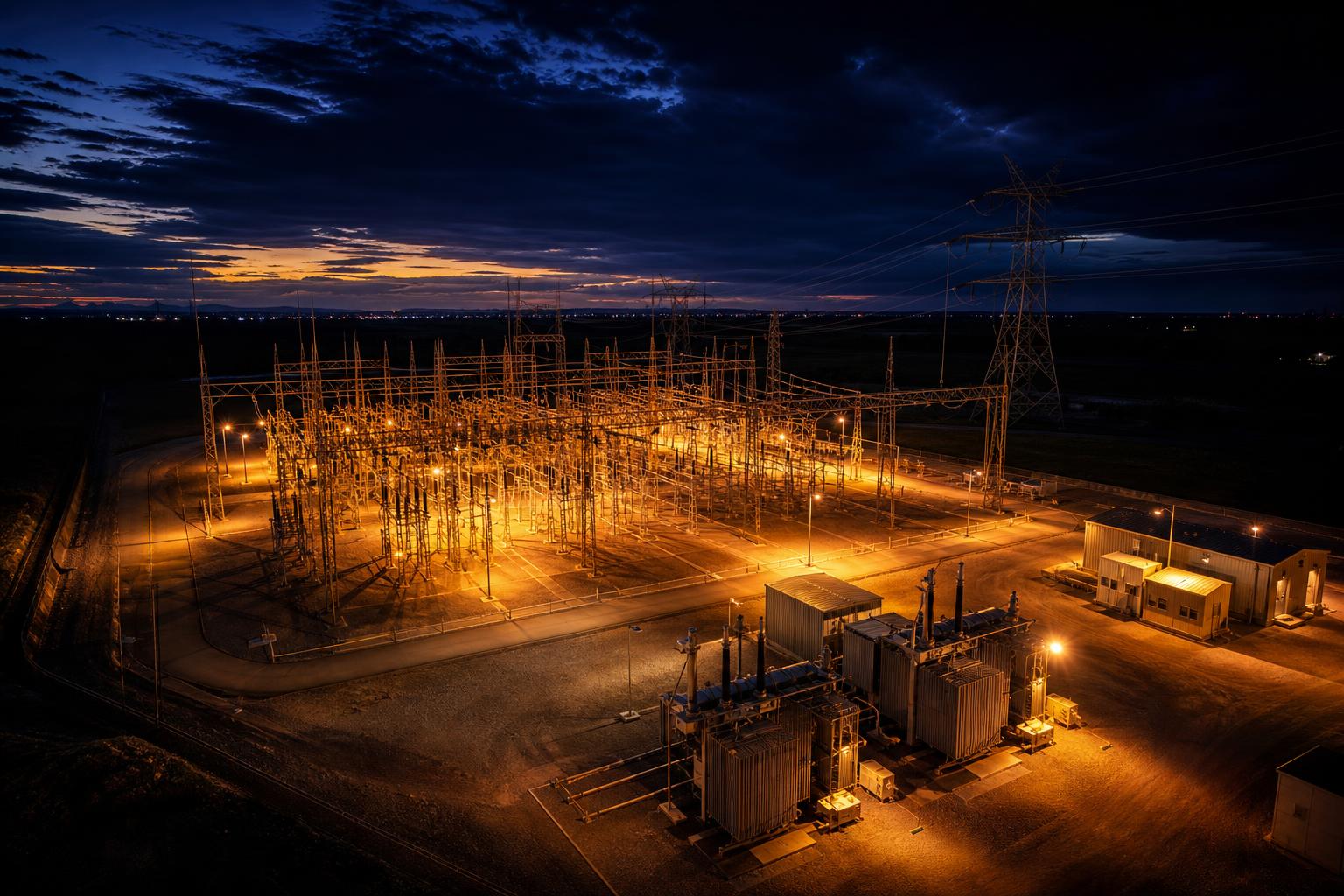
Energy & Utilities operating environmentIllustrative environment · not a client deployment
PRINCIPLE

Energy & Utilities

How should changing conditions reshape the response?

CONNECTS
Telemetry, topology, outage plans, crews and weather.
OPERATING VIEW
Asset state and crew readiness considered together.
NEXT DECISION
Review the response plan. Authorize the next dispatch.
Logistics & Supply Chain operating environmentIllustrative environment · not a client deployment
PRINCIPLE

Logistics & Supply Chain

Where are supply risk and operating urgency out of step?

CONNECTS
Inventory, suppliers, contracts and work demand.
OPERATING VIEW
Supply exposure connected to the work it could delay.
NEXT DECISION
Resolve the constraint. Route the purchasing decision.
Commercial Operations operating environmentIllustrative environment · not a client deployment
PRINCIPLE

Commercial Operations

What changed, and what does it do to the plan?

CONNECTS
Cost, schedules, scope, contracts and staffing.
OPERATING VIEW
Variance with its source, owner and operating consequence.
NEXT DECISION
Compare the options. Approve the program change.
Real Estate & Property Management operating environmentIllustrative environment · not a client deployment
PRINCIPLE

Real Estate & Property Management

Which sites are drifting, and what is driving it?

CONNECTS
Property records, service events, finance and obligations.
OPERATING VIEW
Portfolio comparisons grounded in explicit operating definitions.
NEXT DECISION
Choose the site action. Record the accountable owner.
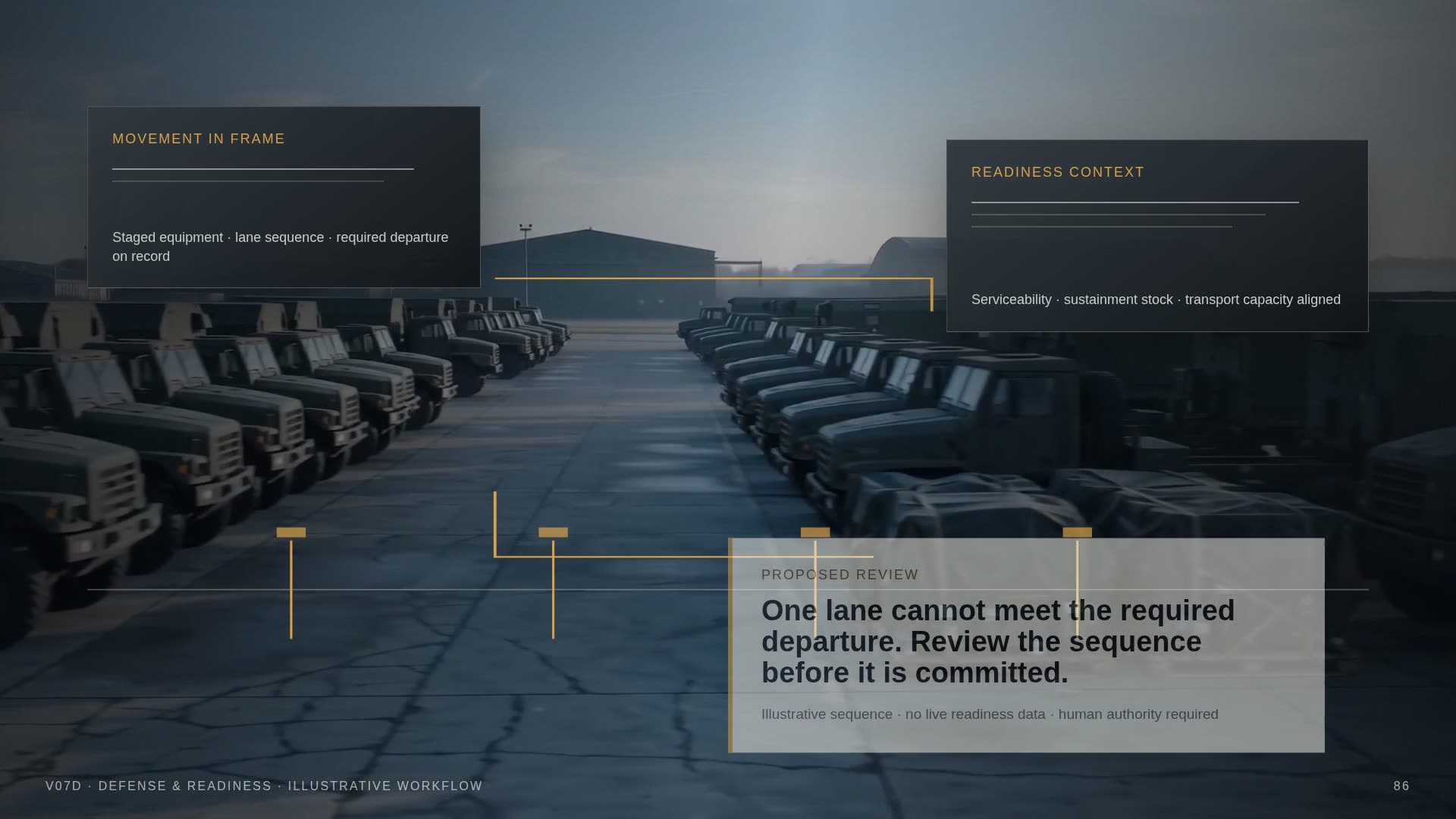
Defense & Readiness operating environmentIllustrative environment · not a client deployment
PRINCIPLE

Defense & Readiness

Which readiness gap threatens the mission?

CONNECTS
Asset, maintenance, supply, training and facilities records.
OPERATING VIEW
Readiness gaps traced to their authoritative source.
NEXT DECISION
Review the gap. Coordinate an authorized response.

Operating scenarios are design principles, not deployment claims. Evidence from one engagement does not transfer across industries.

01 / The thesis

AI is abundant. Your operating record is not.

ESTABLISHED

One national operator's estate held several hundred datasets and more than twenty thousand columns. Fewer than half had a documented owner and defensible definition. The data was extensive. The meaning was missing.

Anyone can buy

  • ·Models
  • ·Warehouses
  • ·Dashboards
  • ·Agents

Only you can accumulate

  • 01What was known
  • 02What was decided
  • 03What was done
  • 04What happened
  • 05What was learned
PRINCIPLE

Your platforms stay the systems of record. VULCAN is the governed layer above them.

The advantage is not the model. It is the record of what was decided and what happened next.

Fig 08 · Intelligence flywheel

coded surface · illustrative

PRINCIPLE

The intelligence flywheel

One segment cannot be bought

CURRENT LAYERLearningimproves the next turn
Data to context to prediction to decision to action to outcome to learning; the ember return is the part no competitor can buy.
Metro skyline edge with operator portfolio, commercial and mid-rise properties at dusk

the thesis · at portfolio scale

Every figure on the surface resolves to the operating unit inside an asset someone is responsible for.

How to read every claim on this page

ESTABLISHED

What has been observed, measured, or verified in the sector or in a stated engagement.

PRINCIPLE

A design commitment this brief argues for. It constrains the build unless deliberately amended.

The marking stops an aspiration from being read as a commitment.

02 / The constant

Connect the operation. Keep people accountable.

ESTABLISHED
01

Accountability holder

Owners and investors

Returns against what was underwritten, and the obligations that come with the capital.

System boundary

The third-party operator's PMS, CRM, finance and field systems.

02

Accountability holder

Asset managers

Business plan, CapEx, hold-or-sell, and the reporting behind each.

System boundary

The definitions the operating teams use to produce the numbers.

03

Accountability holder

Compliance and fund stakeholders

Contract compliance periods, covenant tests, audit evidence on demand.

System boundary

The systems where the underlying events are recorded.

04

Accountability holder

Government stakeholders

Standards and outcomes at installation facilities.

System boundary

The operating systems of the companies running the properties.

PRINCIPLE

Every fact carries its source, permission, time and decision.

The next estates

Installations.
The same shape: facility-related control systems for power, HVAC and water, fragmented across vendors, operationally critical. No deployment exists today.
Utilities.
Metered estates where the invoice and the meter never reconcile. No engagement exists today.

Asset-class agnostic by design.

Fig. The IT/OT seamPRINCIPLE

IT

Business systems · what was charged

  • Billing system
  • Finance and ERP
  • Work order system
  • Commitments and contracts

OT

Equipment systems · what the meter recorded

  • Meter register
  • Building controls
  • SCADA and telemetry
  • Access control

The question that needs both

The meter recorded one number. The billing system charged another. Which one can the operator defend?

Illustrative of the surface, stated as a design principle. No delivered work is claimed.

the plant room · illustrative

Different assets carry different obligations. Accountability still lands with one operating team.

03 / The system

From signal to verified outcome.

PRINCIPLE

Perceive

Environment, assets and OT signal, time-stamped raw capture

Meters, controls, finance, work orders and field capture, each attributed to its source

Interpret

Raw signal becomes detections, states and anomalies

Consumption, exceptions, backlog and service state, against the operating calendar

Model

Detections resolve against the mission ontology

Facility, asset, obligation, client, decision and outcome as governed objects

Decide

Reasoning bounded by policy and evidence

A cited answer, or an abstention where evidence is thin

Act

Approved actions route into systems of record with lineage

An assigned action with a named approver, bounded scope and a rollback path

Prove

Outcomes resolve against the original decision and baseline

The result, its evidence and any exception return to the operating record

PRINCIPLE

Built around the stack you already run.

The operational graph

Assets
Equipment, facilities and control systems
People
Operators, field teams and named approvers
Places
Sites, plants, installations and zones
Tasks
Work orders, inspections and corrective actions
Risks
Failure modes, exposure and readiness gaps
Costs
Budget, spend, downtime and resource impact
Approvals
Authority, permissions and escalation
Decisions
Rationale, action, outcome and audit trail

Conceptual, not a customer ontology.

A traceable decision

Source
Observed fact, time and authority
Approval
Named person, permission and rationale
Outcome
Receiving-system state and recorded result

Integrate, not replace

Business systems
Finance, ERP, work orders, contracts and identity
Equipment systems
Meters, building controls, telemetry and approved sensing

Client-controlled boundaries

  • Client-owned environments and governed data platforms
  • Edge and OT network boundaries
  • Identity, permissions and approved receiving systems
  • Client-selected models and sensing outputs, when approved

Design commitments, not deployed integrations.

Evidence to recorded outcome

PRINCIPLE
Perceive01 / 06
  • 01Perceivegoverned evidence, at unit level
  • 02Interpretcontext, definitions, authority
  • 03Modeloperating relationships and scenarios
  • 04Decidescenario + recorded rationale
  • 05Actcontrolled execution in-system
  • 06Provemeasured outcome returns as signal
  • ↺ every outcome returns as the next signal

Answer or abstain

PRINCIPLE

governed answer

ledger row 2,431

The meter at Building 4 recorded 41,206 kWh in March. The billing system charged 44,910. The difference sits in three submeters never mapped to a suite.

Source · Meter register · authoritativeObserved · 06:15 todayDefinition · billback_kwh v2Level of detail · meter · monthConfidence · measuredAccess · client-scoped

Why

  • 2,840 kWhUnmapped submeters, west wing
  • 612 kWhCommon-area allocation with no clause basis
  • 252 kWhEstimated read carried twice
Assign ownerModel scenarioOpen decision recordView evidence

What travels with it

Authority · Definition · Confidence · Approval

Measured, inferred or forecast, never blurred together.

Authority
Source, lineage and owner shown on the answer itself.
Definition
Metric linked to its level of detail, formula and version.
Confidence
Measured, inferred or forecast, never blurred together.
Approval
Action routes to an accountable person, not a model.

And a governed refusal

I cannot answer this at meter level. Two sources disagree on the circuit mapping and the conflict is unresolved; a stewardship exception is open and assigned. Here is what I can support: building-level consumption, reconciled as of yesterday.

PRINCIPLE

Five operating experiences.

VULCAN

Illustrative surface · not live client data

Mission control · portfolio

Run

Command

Surfaces change, ranks exceptions and assigns owners, portfolio to asset.

Executives · regionals · asset management · clients

Obligations due

82.4%

6.2 pt lower

Assets at risk

148

+21

Open exceptions

12

3 fewer

  • Building 4 · west wing

    Billback gap opened, 3 weeks

    Owner assigned
  • North plant

    Shutdown slipping on 14 work orders

    Escalated
  • Tower 2

    Certification close rate down

    Under review

01 / 05 · Command

What VULCAN is not

  • ×A replacement for your PMS, ERP or engagement tools.
  • ×Another BI dashboard environment.
  • ×A generic chatbot over ungoverned tables.
  • ×Unsupervised autonomous decision-making.

the operating floor · where the week is decided

The same record on every screen, so the meeting argues about the decision, not the numbers.

04 / The diagnostic

Start with trusted evidence.

Eight acceptance gates establish the sources, authority and boundaries before a workflow runs.

PRINCIPLE

Discovery standard / 08 gates

And do not accept it until

Dataset census

Dataset census

And do not accept it until

Every dataset enumerated with columns, row volume, owner and last refresh

Authority registry

Authority registry

And do not accept it until

Each dataset scored for authority; score, basis and reviewer recorded and reproducible

Duplicate resolution

Duplicate resolution

And do not accept it until

Recut datasets identified, the survivor named, lossy recuts flagged

Identifier profile

Identifier profile

And do not accept it until

Candidate keys profiled; collisions and drift documented, never corrected in silence

Crosswalk

Crosswalk

And do not accept it until

An explicit bridge between the analytics key and the system-of-record identifier; exceptions quarantined, not merged

Boundary matrix

Boundary matrix

And do not accept it until

Every dataset assigned a tier; those barred from broad pipelines listed explicitly

includedeferreject

Ingestion manifest

Ingestion manifest

And do not accept it until

A deterministic include, defer or reject call per dataset, diffable between runs

Expectations suite

Expectations suite

And do not accept it until

Automated expectations that fail the build, not a report read afterwards

Unit of account / obligation register

Where the obligation lands.

Operator portfolio is established; every other pairing is a PRINCIPLE design commitment, not a deployment claim or a capability shipping today.

Operator portfolio

ESTABLISHED
Unit of account
The unit
Carries
The lease and its counterparty

Commercial

PRINCIPLE
Unit of account
The suite
Carries
The lease clause and its obligation

Industrial

PRINCIPLE
Unit of account
The asset and its control loop
Carries
The work order and its permit

Energy and utilities

PRINCIPLE
Unit of account
The meter and its circuit
Carries
The tariff and the billback

Defense installation

PRINCIPLE
Unit of account
The facility and its control system
Carries
The readiness obligation

Facilities and field

PRINCIPLE
Unit of account
The facility and its service route
Carries
The work order and its service level

Logistics

PRINCIPLE
Unit of account
The node and its dock
Carries
The throughput commitment

Critical infrastructure

PRINCIPLE
Unit of account
The asset and its criticality tier
Carries
The compliance obligation

The diagnostic establishes the unit first. It does not transplant operator portfolio measurements into another industry.

PRINCIPLE

The gates contain no sector content.

Dataset census
Counts datasets
Authority registry
Scores authority
Boundary matrix
Assigns tiers

Only the unit of account changes. Portability is a design principle, not evidence of deployment on every estate.

Explore the eight industry operating scenarios ↑

05 / The scorecard

Five outcomes, measured on your baseline.

PRINCIPLE

Before shipping, each capability names its target, owner, baseline, mechanism, and the measurement plan that will confirm or disprove the claim.

Technician completing a certified repair on plant equipment
01

Assurance

Client and owner

Every obligation the estate carries is met, and the evidence is on the record.

First
Obligations closed on time
Then
Shorter reporting cycles
Lands
Renewed on the evidence
Operations room monitoring service levels across the estate
02

Living

Occupant and user

The people using the facility get the service that was promised to them.

First
Service levels honored
Then
Response times honored
Lands
Service proven, not asserted
Leadership reviewing one shared operating record
03

Leverage

Operating capacity

Leaders spend their time deciding, not reconciling.

First
Time to an answer falls
Then
Rework avoided
Lands
More coverage per leader
Stacked ledger paper in raking light
04

Integrity

Resilience

Controls and evidence are there when someone asks.

First
Exceptions surfaced while fixable
Then
Audit evidence on demand
Lands
Obligations met before deadline
Industrial bay under a planned maintenance window
05

Net performance

Cost and asset plan

Cost and asset performance hold against plan, and the company knows why.

First
Variance explained, not estimated
Then
Unplanned cost contained
Lands
Actual against plan
Swipe the scorecard · 01 / 05

Fig 05 · Five-year compounding

coded surface · illustrative

PRINCIPLE
PRINCIPLE

Advantage over five operating years · illustrative

With a decision recordDashboards alone
YEAR 12345THE GAP COMPOUNDS

Illustrative. The record accumulates only through operating; each year it survives, it is worth more and harder to reproduce.

The decision record compounds. Dashboards alone stay flat; the gap compounds.

06 / The proof case

The method, worked once.

What the eight gates returned on one operator portfolio estate.

One diagnostic. One operator portfolio estate.

ESTABLISHED

Several hundred datasets, twenty thousand columns, under half with a documented owner, three percent meeting the authority threshold.

One engagement, not a sector benchmark. No client named; no measurement transfers to another estate.

Fig 02 · Position map

coded surface · illustrative

PRINCIPLE
Hold the standard
Watch: Compliance exceptions
Clear the register
Watch: Backlog age
Plan the renewal
Watch: Deferred maintenance liability
Stabilize first
Watch: Unplanned downtime
Estate condition against obligation load: four positions, four plays.

07 / The 90-day forge

One operation. One question. Ninety days.

Measured against a matched control, limits published.

10 / Sovereignty

Seven layers. Your operating record stays yours.

PRINCIPLE
  1. 01 / Data boundary
  2. 02 / Compute and runtime
  3. 03 / Model choice
  4. 04 / Semantic definitions
  5. 05 / Governed workflows
  6. 06 / Decision rights
  7. 07 / Operating record

Design commitments. Ownership, data location, retention, model use, approval and export are defined in engagement terms. The detailed authority is the Sovereignty page.

Review the seven layers and terms →

11 / Appendix and start

Technical blueprint

The full technical blueprint is available under appropriate terms. It covers definitions, boundaries, delivery gates, source notes and the governed object model.

Start

Start with one decision.

We will scope the first governed decision with you: the question, the evidence it needs, the baseline, and how we will know it improved.

Built for platforms running 10k+ facilities or units · 2+ ownership models · 5+ systems in the decision path · 4+ transitions a year.

Request a briefing
+ Sources & data notes
  1. 1PwC & Urban Land Institute, Emerging Trends in Real Estate, 2026. Insurance premiums rising, skilled trade labor in short supply. Source ↗

VULCAN

Ridgeline AI, an Element 29 company · Tampa, FL · N 27°56′ W 82°27′

inquiries@e29ce.com(813) 279-1898

Ridgeline AI builds governed operating layers for complex operations across sectors. Examples on this page are illustrative; no client is named. A full technical blueprint is available under appropriate terms.